In 2026, when we talk about digital marketing, we acknowledge the fact that it is evolving rapidly. Consumer behavior has changed drastically over the last few years. It’s simple: if businesses fail to adapt to these changes, they fail to sustain themselves in the market.
Those days are gone when running ads was enough to get an audience. Now, businesses need to understand consumer needs and deliver customized value at the right time. However, it is important to understand how this change happened. The following are the key reasons:
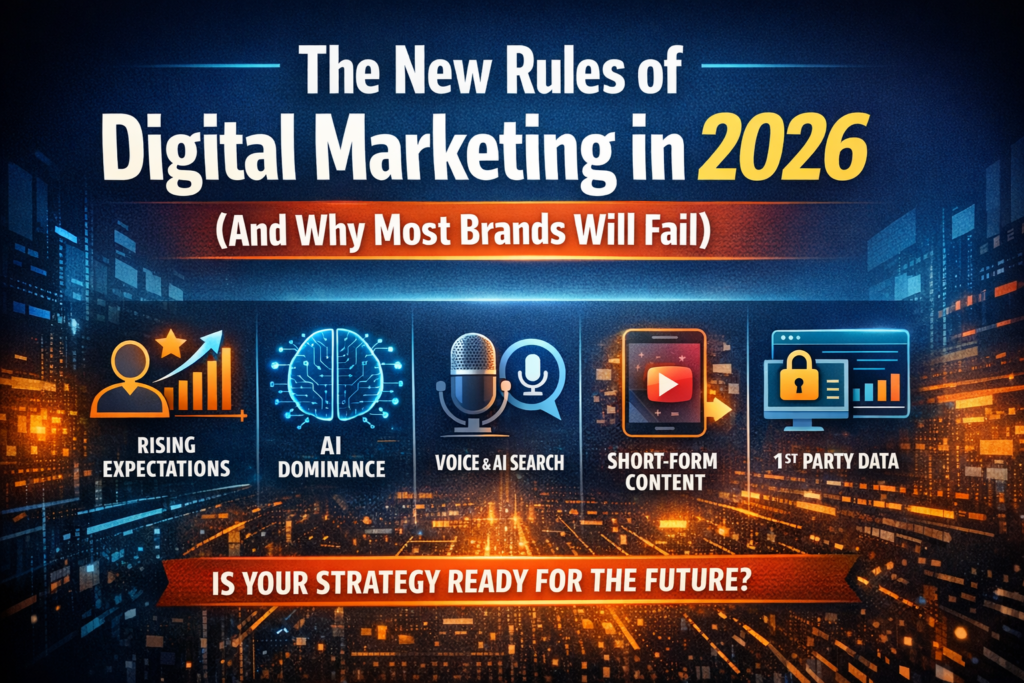
- Customer expectations have increased
As expectations rise, you can’t rely on generic marketing anymore. To reach your audience, your brand needs to deliver personalized experiences, real-time responses, and genuine communication.
- Search behavior
Earlier, users relied on Google and YouTube for solutions. Now, search behavior is evolving, with users shifting towards AI tools and voice search. As a result, SEO is also evolving, and your content needs to be optimized accordingly.
- AI
AI helps in content creation, task automation, and understanding consumer behavior. If your brand is not using AI, it is already behind. AI is improving decision-making and increasing efficiency for businesses. Start using AI tools like ChatGPT, Perplexity, and Gemini for content ideation
- Short-form content
Studies suggest that the average attention span is now around 7 seconds, indicating that people prefer short-form content. Platforms like Instagram and YouTube are dominated by it. However, content should not just be informational; it must also be entertaining to truly engage the audience. Marketing today is becoming more about entertainment than just information. Brands like Zomato use short-form content with humor. We have explained how to use short-form content effectively. Click here
- First-party data
As people are aware that data is collected and used, now businesses do not depend on third-party cookies. Brands focus on first-party data to collect the information. A business can collect data through interaction, websites, and emails.
It is essential to stay updated with these trends and implement them effectively to stay ahead. Digital marketing is no longer about reach; it’s about relevance. Brands that understand this will grow, others will struggle to survive.