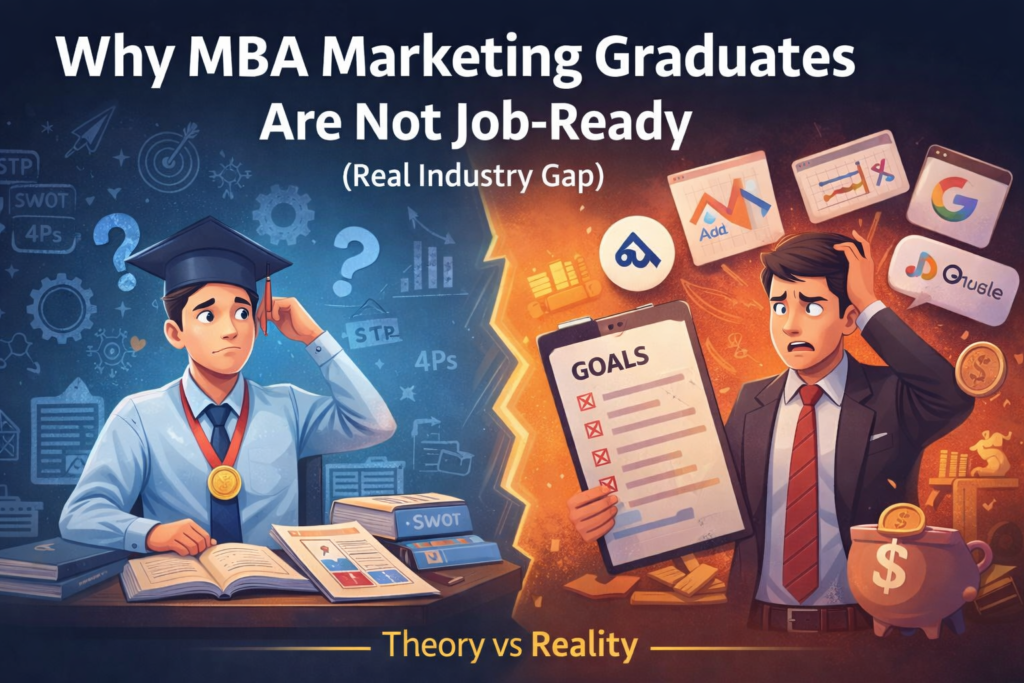
In college, an MBA in marketing gives you structure, concepts, and confidence. You study SWOT, 4Ps, STP, and other marketing concepts, but when you enter the real world, you realize that marketing is more about action than memorizing concepts.
The Biggest Gap
Many MBA graduates struggle to implement basic marketing campaigns or track performance metrics due to a lack of practical exposure in MBA programs. The majority of MBA programs focus on presentations, case studies, and theory, rarely emphasizing the execution of real campaigns.
Can’t Ignore Tools
Many MBA colleges do not effectively teach important tools like Google Ads, Meta Business Manager, or analytics dashboards. These tools are essential in modern marketing. Without them, theory becomes ineffective.
Budget Shock
During an MBA, you are given case studies where you make decisions with large budgets. However, in reality, there is a twist—not every time will you get big budgets. There will be situations where you must rely on creativity and intelligence with limited resources. Budgets are smaller, but expectations remain high.
Sales Pressure
During an MBA, students aim for roles like brand management and strategy. However, in reality, especially in India, the majority of roles demand strong sales skills. Most Tier 3 colleges primarily offer sales roles, where students learn the hard way how markets actually function.
Consumer Behaviour
Consumer behaviour is taught in theory, but in reality, customers are irrational, price-sensitive, emotional, distracted, and influenced by social proof. Real consumer behaviour is far more complex than textbook examples. Students need fieldwork to truly understand it.
Rejections
An MBA does not prepare students for rejection and pressure. In the real world, results matter the most. When students enter the corporate world and face rejection, it creates significant pressure. Some even quit because they were never taught how to handle rejection and stress.
Conclusion
The conclusion is uncomfortable but necessary: an MBA is just a starting point. It gives you language and structure, but not competence. Competence comes from doing, failing, analyzing, and improving.