1. Introduction
In this article, we analyze Swiggy’s marketing strategy and examine how the company acquires customers, increases engagement, and builds long-term retention in India’s highly competitive food delivery market.
Swiggy Marketing Strategy is one of the most successful examples of customer acquisition, engagement, and retention in India’s food delivery industry. In this article, we analyze how Swiggy attracts new users, keeps them engaged, and turns them into loyal customers.
2. Swiggy Marketing Strategy Overview
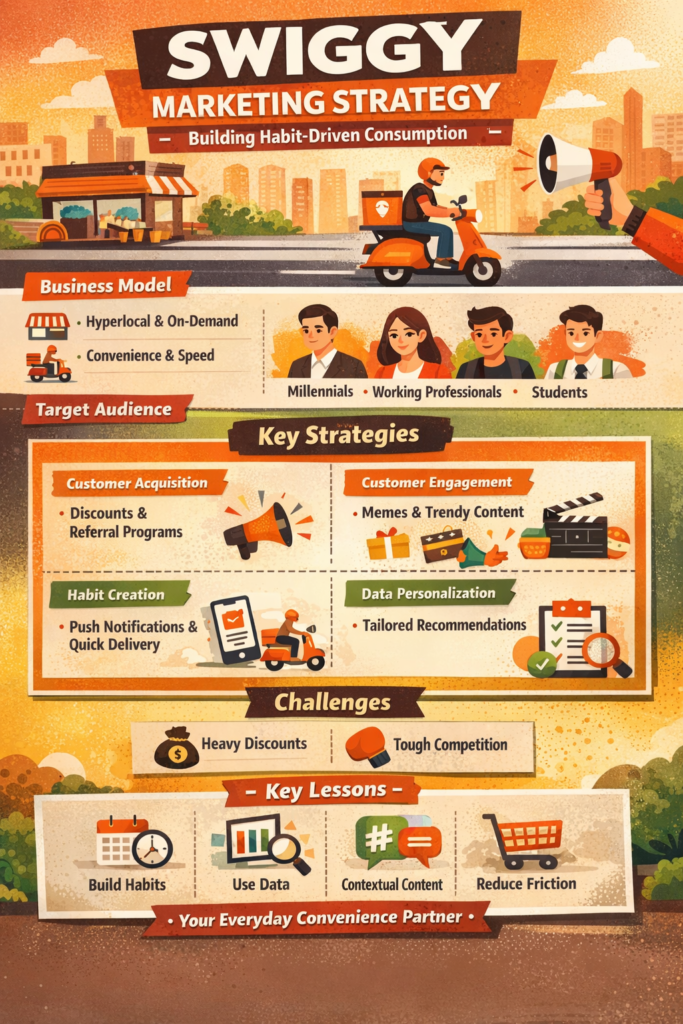
Swiggy connects with restaurants and delivery partners to reach end consumers. It operates as a hyperlocal, on-demand delivery platform. Convenience, speed, and variety are the core value propositions. Swiggy saves time and provides instant gratification, not just food.
3. Swiggy Target Audience
Swiggy targets segments such as urban millennials, working professionals, and students. These users prefer convenience and impulse buying over cost.
4. Customer Acquisition and Retention Strategy of Swiggy
4.1 Customer Acquisition
Swiggy relies heavily on performance marketing and referral programs. It highlights discounts, urgency, and “invite and earn” credits to reduce customer acquisition cost and leverage the network.
4.2 Customer Engagement
Swiggy creates content such as trend-based, relatable, and contextual posts on social media. Examples include cricket match memes, pop culture references, and festival-based creatives. Swiggy doesn’t push products; it embeds itself into daily conversations without forcing them.Brands need to learn from Swiggy how it reacts immediately to viral trends and live events. This increases organic reach and shareability. This reflects a broader shift in marketing where brands focus on participation and conversations instead of simply maximizing reach
4.3 Customer Retention
A. Push Notification Strategy
Swiggy uses behavioural triggers through different types of notifications such as time-based, behavior-based, and offer-based. You must have seen notifications like “lunch time,” “order again from your favourite restaurant,” and “flat ₹100 off.” The reason this works is that Swiggy understands how to capture attention without becoming easy to ignore, something many advertisers struggle with today.
B. Habit Loop Creation
Swiggy builds a loop through trigger, action, and reward. You get a notification, open the app, place your order, and boom – your delivery is on its way quickly. Over time, these occasional habits become daily habits.
C. UX & Convenience
Swiggy has focused on one-click reorder, fast checkout, and personalised recommendations, which reduce friction and increase repeat usage.
5. Brand Positioning
The positioning of Swiggy is “your everyday convenience partner.” This is reinforced through messaging, app experience, and communication tone.
6. Customer Engagement Strategy of Swiggy
6.1 Hyperlocal Marketing
Swiggy offers city-specific deals with local restaurants. This helps in maintaining relevance across different customer preferences and regions.
6.2 Discount-Led Growth
Swiggy relies heavily on discounts and offers. For new customers, Swiggy provides attractive offers that boost orders. However, this affects customer loyalty in the long run, as customers begin to expect continuous discounts, which may lead them to switch platforms.
6.3 Data-Driven Personalization
Swiggy tracks customer data such as order history, which helps the company personalise recommendations, targeted notifications, and overall user experience. Even small businesses can now use AI-powered marketing tools to better understand customer behavior and improve engagement.
6.4 Content + Culture Integration
Swiggy uses current trends and pop culture in its meme marketing, which helps in relatability and audience engagement.
7. Challenges for Swiggy
- Swiggy needs to reduce overdependence on discounts, as it can impact customer loyalty in the long run. Heavy discounts attract price-sensitive users.
- High competition from Zomato is a major challenge.
- High logistics and operational costs.
8. Key Marketing Lessons from Swiggy
- Build habits, not just traffic.
Swiggy, instead of focusing only on acquisition, focuses on building customer habits, which is a long-term strategy. - Use data.
Swiggy uses behavioural data, which helps in timing and personalisation. - Contextual content.
Content should have context; it helps in relevance. - Reduce friction.
The better the UX, the higher the retention.
Also read our breakdown on branding lessons from Apple.
Conclusion
Swiggy’s success is not just driven by marketing spend.
It is driven by behavioural understanding, data-driven execution, and habit formation.
In a crowded market, Swiggy doesn’t just compete for attention.
It competes for daily relevance in users’ lives.