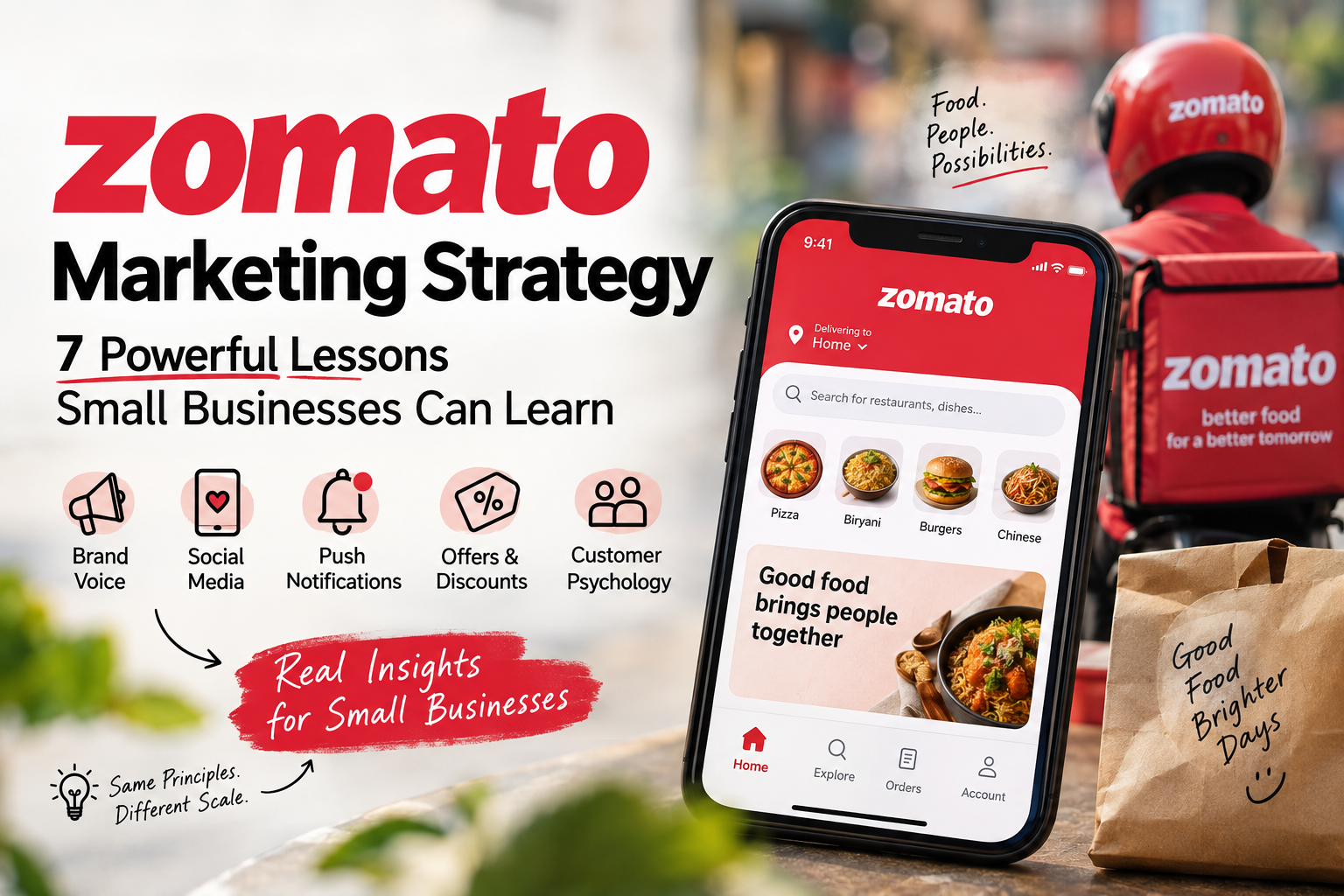
Zomato’s marketing strategy is much more interesting than simply promoting food delivery. The company has built a recognizable communication style across social media, notifications, advertising and the overall customer experience. What makes the strategy interesting is how Zomato combines timing, customer psychology, data and a consistent brand voice to make ordinary marketing messages more noticeable.
For a small business, copying Zomato’s exact tactics would make little sense. A local restaurant, salon or retailer does not have Zomato’s scale, technology or customer data. But the underlying principles are much easier to apply. So instead of simply describing what Zomato does, I wanted to break down why some parts of the Zomato marketing strategy work and what a small business can actually learn from them.
Zomato Marketing Strategy: Building a Recognizable Brand Voice
One of the most recognizable parts of Zomato’s marketing is its brand voice. Its communication is generally conversational, witty, topical and sometimes self-aware. Instead of making every message sound like a formal advertisement, Zomato often communicates in a way that feels closer to everyday internet conversations. This approach has appeared across its social content and notification-driven marketing.
This matters because people are exposed to hundreds of marketing messages every day. A small business does not necessarily need to spend more money to compete for attention. It can also make its communication more recognizable. If a local café always communicates in a particular tone, uses familiar language and understands the personality of its customers, people can gradually begin to recognize the business even before seeing its logo.
The important lesson here is not simply “be funny.” Humour works for Zomato because it is part of a broader and consistent communication style. If every business suddenly starts copying internet jokes, the result is not differentiation. The better question is: How should your brand sound if it had a personality?
Social Media Is Not Just About Posting
Zomato’s social media strategy is another good example of using content to remain part of everyday conversations. Food is naturally connected with festivals, movies, cricket, relationships, work, college, weekends and countless other situations. That gives the brand a huge number of cultural moments it can connect with.
The important part is relevance. A brand does not have to force itself into every trending topic just because something is viral. The connection needs to make sense. Zomato’s marketing has often worked by taking a familiar situation and connecting it back to food in a simple way. That makes the content easier to understand and more likely to be shared.
A small business can use the same principle without having a large social media team. A local restaurant could create content around exam season, rainy evenings, cricket matches, office lunch or local events. The objective is not to become a meme page. The objective is to understand what your customers are already talking about and find a natural connection with your product.
This is also where understanding your audience becomes important. Before creating content, businesses should know what their customers are actually searching for, asking about and interested in. This is where keyword research can provide useful insights into customer interests and search behavior. Keyword Research: Beginner-Friendly Tips to Master SEO
Zomato is not the only food-delivery brand that has built its marketing around understanding customer behavior and staying relevant in everyday situations. Swiggy has followed its own approach to brand building and customer engagement, which I have analyzed in [Swiggy’s growth strategy].
Zomato Marketing Strategy and Push Notifications
This is probably one of the most interesting parts of the Zomato marketing strategy. A push notification is normally a very functional communication channel. An app tells you that your order has been placed, delivered or that an offer is available. Zomato has also used notifications as a way to communicate its personality and create attention around the message itself.
The difference is important. A normal promotional message gives you information. A well-written message can give you a reason to pay attention. When the communication is relevant to the moment and sounds like the brand, the notification becomes more than a sales message.
The lesson for small businesses is surprisingly simple. Do not treat every customer message like an advertisement. If you run a salon, instead of repeatedly sending “20% OFF THIS WEEK,” you could communicate around a relevant occasion, customer problem or seasonal need. The offer can still exist, but the communication surrounding it can make the message more interesting.
A small business may not have a sophisticated app with millions of users, but the principle can be applied through WhatsApp, SMS or email. The technology is different, but the marketing idea remains the same: make the message relevant instead of simply making it promotional.
Timing Is Part of the Zomato Marketing Strategy
A good message at the wrong time can be completely useless. Zomato’s marketing demonstrates the importance of connecting communication with context. Food is particularly suitable for this because customer demand changes throughout the day. Lunch, dinner, weekends, weather and special occasions can all change what people want.
Zomato operates in an environment where customer behavior can be analyzed around factors such as location, customer segments and timing. This allows marketing communication to become more relevant instead of treating every customer in exactly the same way.
This gives us a broader marketing lesson: relevance is not only about what you say; it is also about when you say it.
A small business can apply this without sophisticated technology. A gym can communicate with potential customers around the beginning of a month. A bakery can promote cakes before occasions when people actually buy them. An agricultural business can communicate with farmers around relevant crop cycles rather than sending the same message throughout the year.
The difference between random promotion and useful marketing is often simply understanding when the customer actually needs you.
Zomato Understands Customer Psychology
Food is an emotional category. People do not always order because they have carefully planned a meal. Sometimes they are hungry, tired, celebrating something, working late or simply do not want to cook. Zomato’s communication frequently works within these everyday situations rather than treating food as a purely rational purchase.
This is where marketing becomes more interesting. The customer may think they are simply choosing between two restaurants, but several psychological factors can influence that decision: convenience, price, familiarity, reviews, cravings, urgency and the effort required to make a decision.
For a small business, understanding this is more useful than simply copying Zomato’s social media style. Ask yourself: What situation causes my customer to buy? What problem are they trying to solve? What hesitation stops them from buying?
Once you understand those questions, your marketing becomes much more specific. Instead of creating content simply because you need to post something today, you can create communication around an actual customer need.
Offers Are About More Than Discounts
Discounts are one of the most obvious parts of food-delivery marketing, but simply giving a discount does not automatically create a good strategy. The offer has to make sense in the customer’s decision-making process.
Sometimes a customer already wants something but needs a small reason to complete the purchase. In other situations, an offer can encourage someone to try a new restaurant or product. Promotional marketing can also be used to introduce a new product, attract customers during slower periods or encourage existing customers to purchase again.
Small businesses can learn from this by asking what their offer is actually supposed to achieve. Is it bringing in a new customer? Increasing repeat purchases? Promoting a new product? Filling a slow period? If the answer is unclear, simply putting “20% OFF” on a poster may not solve the underlying problem.
A good offer should have a purpose. The discount itself is not the strategy. The reason behind the discount is the strategy.
Convenience Is One of Zomato’s Biggest Marketing Advantages
There is another part of Zomato’s strategy that is easy to overlook because it does not always look like marketing: convenience.
The customer can discover restaurants, compare options, look at menus, place an order and track the delivery within one ecosystem. That reduces the amount of effort required to make a purchase.
This is a powerful lesson for small businesses because marketing does not stop when someone sees your advertisement. If the customer becomes interested but then has to search for your phone number, ask for the menu, wait for a reply and figure out how to pay, some of that marketing effort can be wasted.
Your Google Business Profile, website, WhatsApp, menu, payment options and customer service should work together to make the buying process easier.
Good marketing gets attention. Good customer experience makes that attention useful.
This is also connected to search visibility. When customers search for a local business, the information they see can influence whether they contact or visit that business. Understanding the difference between different search and advertising approaches is another important part of modern digital marketing. SEO vs SEM: Which Strategy Is Better for Your Business in 2026?
Zomato Marketing Strategy Uses Data, But the Principle Matters More
Zomato operates at a scale where data can be used to understand customer behavior, locations, segments and other factors that can influence marketing communication. This allows the company to make its advertising and promotional activity more targeted.
A small business obviously cannot replicate that infrastructure. But it can still use customer information in a basic way.
Suppose a local restaurant notices that certain customers repeatedly order biryani on weekends. Instead of sending every customer the same message, it could create a more relevant offer or reminder for that particular customer segment. A salon could separate new customers from regular customers. A retailer could identify which products different customer groups buy most often.
You do not always need complicated software to start thinking this way. Sometimes a spreadsheet and consistent record-keeping are enough.
The important lesson from the Zomato marketing strategy is not that every business needs sophisticated technology. It is that businesses should pay attention to customer behavior and use what they learn.
What Small Businesses Can Learn From Zomato
The biggest mistake would be to look at Zomato and conclude that the lesson is “make funny Instagram posts.” That is only the visible part of the strategy.
The deeper lesson is about understanding the customer and connecting different parts of marketing together. Zomato combines brand voice, social content, notifications, offers, targeting and convenience rather than treating each activity as completely separate.
A small business can apply the same thinking on a much smaller scale. Develop a recognizable communication style. Understand when your customers are most likely to need your product. Create offers with a specific purpose. Make your messages relevant to customer situations. Keep your Google Business Profile and social media updated. Make it easy for someone to move from discovering your business to actually contacting or buying from you.
The tools may be different, but the marketing principle remains the same: understand the customer first, then build your communication around them.
What Small Businesses Should Not Copy
There is also an important lesson in what not to copy. Zomato has a huge customer base, significant data infrastructure, an established brand and a team capable of producing content at scale. A small business trying to copy every meme, trend or campaign would probably spend more time imitating Zomato than understanding its own customers.
The objective should never be to become a smaller version of Zomato. A local business has something Zomato does not have at the same scale: direct relationships with a specific community.
A local restaurant knows its neighborhood. A local retailer knows its regular customers. An agricultural business understands the farmers it serves. That knowledge can become a marketing advantage if the business actually uses it.
Instead of asking, “How can I copy Zomato?”, a better question is “What is Zomato doing that I can adapt to my own customers and resources?”
That shift in thinking is much more useful for a small business.
Final Thoughts
After looking at the Zomato marketing strategy, the biggest lesson I take away is that effective marketing is not always about saying more. It is about saying something relevant, in the right way, at the right time.
Zomato’s marketing works across different touchpoints because the brand has a recognizable personality and a strong understanding of the situations in which its customers make decisions. Its social media, notifications, offers and targeting may look like separate tactics, but they are connected by the same basic idea: understand the customer and make the communication feel relevant to them.
For a small business, the takeaway is not to copy Zomato’s jokes or spend more money on advertising. It is to understand your own customers better, communicate like a real brand, remove friction from the buying process and give people a reason to remember you.
That is the part of Zomato’s marketing strategy worth learning from.
References
- Zomato – SocialAds
- Zomato – Rebranding Zomato
- Glance – Zomato Marketing Case Study