Why some blogs don’t rank
There are many cases where a well-written, high-quality blog fails to generate traffic this happens because Google ranks relevancy over content. Therefore, you need to understand the intent of the user. Along with keywords, length, and design, search intent is also essential for a blog; therefore, you can’t ignore it.
What is Search Intent
It means why a person is searching for a particular thing, what their purpose is, and what they need.
For example:
- “best bag under 2000” – wants to buy
- “what is digital marketing?” – wants to learn
- “Amazon login” – wants to go to a website
So, whenever you are planning to create content, do think about search intent.
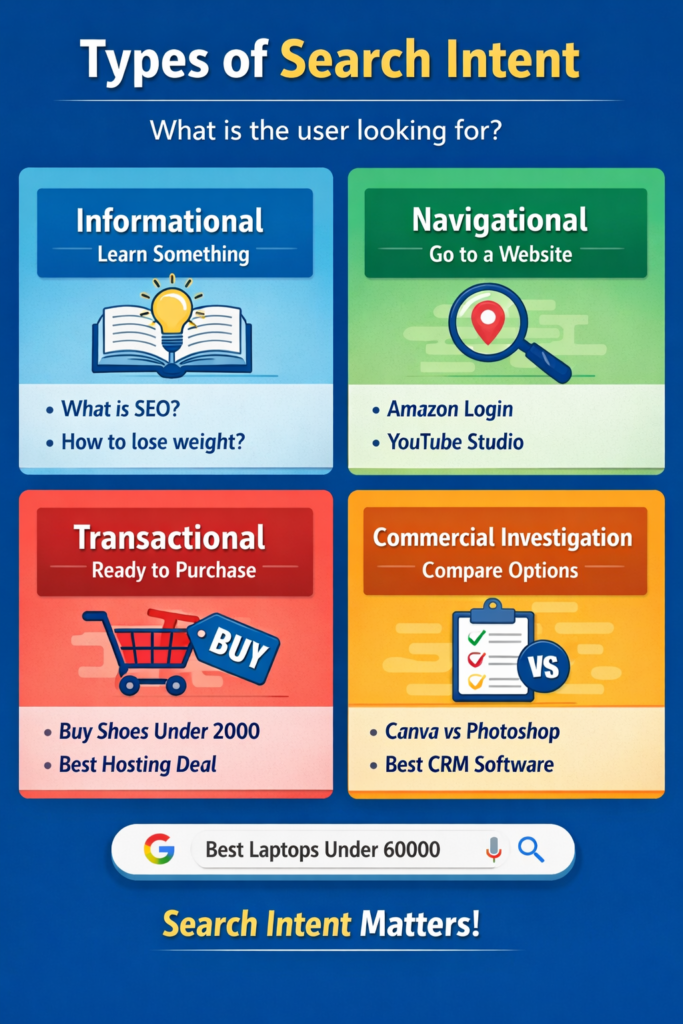
Types of Search Intent (With Real-Life Examples)
1. Informational Intent (Learning)
The user wants to learn something or get an answer to a question. In this case, there is no immediate buying involved.
For example, If a user searches for terms like “what is,” “how to,” “why,” “guide,” “tips,” or “examples,” it shows that the user wants to learn something, which comes under informational intent.
Examples:
- what is digital marketing
- why SEO is important
- how to lose weight at home
You need to be clear in your explanation, provide a step-by-step breakdown, and keep the structure beginner-friendly.
2. Navigational Intent (Finding a Specific Site)
In this case, the user knows their fixed destination; they are just using search to reach it faster.
If a user searches for brand names, website names, products, or platforms, it comes under navigational intent.
Examples:
- Amazon website
- Facebook Ads Manager
- Instagram login
3. Transactional Intent (Ready to Buy)
This type is essential for generating revenue. The user is ready to take action, such as subscribing, signing up, or buying.
Here, the intent is high and patience is low. Therefore, users expect quick results. Users search for terms like buy, price, discount, best deal, subscribe, and order now.
Users expect:
- comparison
- clear pricing
- quick help
- reviews and ratings
- a simple next step (buy/sign up)
Your content should not slow down the process; otherwise, they will leave the website.
You should create:
- product pages
- comparative content
- review content
4. Commercial Investigation (Comparing Options)
Here, the user compares products before buying. So, they are close to making a decision
Keywords include: best, top, vs, comparison, and alternatives.
Examples:
- Canva vs Adobe Photoshop
- top digital marketing courses in India
- best CRM for small companies
They expect:
- clear comparison
- pros and cons
- no bias
How to Match Content with Search Intent
This is where most people fail to implement. however, this step is very important.
Step 1: Search your keyword on Google and note the top 5 results in your Excel sheet.
Step 2: Look for a pattern. Are they blogs, product pages, lists, or videos?
Step 3:
- If top results are list articles → write a list
- If they are reviews → write reviews
- If they are guides → write a guide
Step 4: Look for the essence of the content.
For example: “best laptop under 60000 for gaming” — here the angle is gaming performance, not battery or camera. So in this situation, write: “Top 5 best gaming laptops under 60000 in 2026.”
Key Learning
You need to understand what exactly the user wants, because that decides your content direction.
and accordingly, you have to create the content.
Before writing anything, ask: “What is the user trying to achieve?”. Why Most Digital Marketing Strategies Will Fail in 2026