
SEO vs SEM is one of the first concepts you’ll come across when learning digital marketing, you’ve probably heard the terms SEO and SEM everywhere.
At first, I thought they were basically the same thing.
Both help businesses appear on Google. Both bring website traffic. Both are used by marketers.
So what’s the actual difference?
The easiest way to understand it is by looking at Google itself.
Search for something like “best smartphone under ₹20,000.”
You’ll notice that the first few results often have a small “Sponsored” label. These are advertisements that businesses are paying for.
Below those ads, you’ll see the normal search results that Google ranks naturally.
That’s where the difference begins.
The sponsored results are part of SEM.
The organic results are part of SEO.
Let’s break it down.
What Is SEO in SEO vs SEM?
SEO (Search Engine Optimization) is the process of helping your website rank higher in Google’s organic search results.
In simple words, you’re not paying Google to show your website. Instead, you’re creating useful content and improving your website so Google believes it deserves to rank.
Think about a bakery in Kanpur.
Suppose the bakery publishes a blog called:
“Best Birthday Cakes in Kanpur: Prices, Designs, and Ordering Tips.”
If the article is genuinely useful, optimized properly, and answers people’s questions, Google may start showing it when someone searches for birthday cakes in Kanpur.
The bakery gets visitors without paying Google every time someone clicks.
That’s SEO.
Some common SEO activities include:
- Keyword research
- Writing helpful content
- Internal linking
- Improving website speed
- Optimizing titles and meta descriptions
- Building website authority
The biggest advantage?
Once your content starts ranking, traffic can continue coming for months or even years.
The downside?
SEO requires patience. Results usually don’t appear overnight. Businesses often use both short-form and long-form content as part of their content strategy.

What Is SEM in SEO vs SEM?
Now let’s talk about SEM.
SEM (Search Engine Marketing) usually refers to paid search advertising through Google Ads.
Instead of waiting for Google to rank your website, you pay to appear at the top of search results.
Imagine you own a mobile phone shop in Kanpur.
You want customers immediately.
You run Google Ads targeting keywords such as:
- Buy smartphone in Kanpur
- Mobile shop near me
- Best phone offers today
When someone searches for those keywords, your ad can appear above the organic results.
Every click costs money.
This model is called Pay-Per-Click (PPC).
The biggest advantage of SEM is speed.
You can launch a campaign today and start getting visitors today.
The disadvantage is equally simple.
When you stop spending money, the traffic stops too.
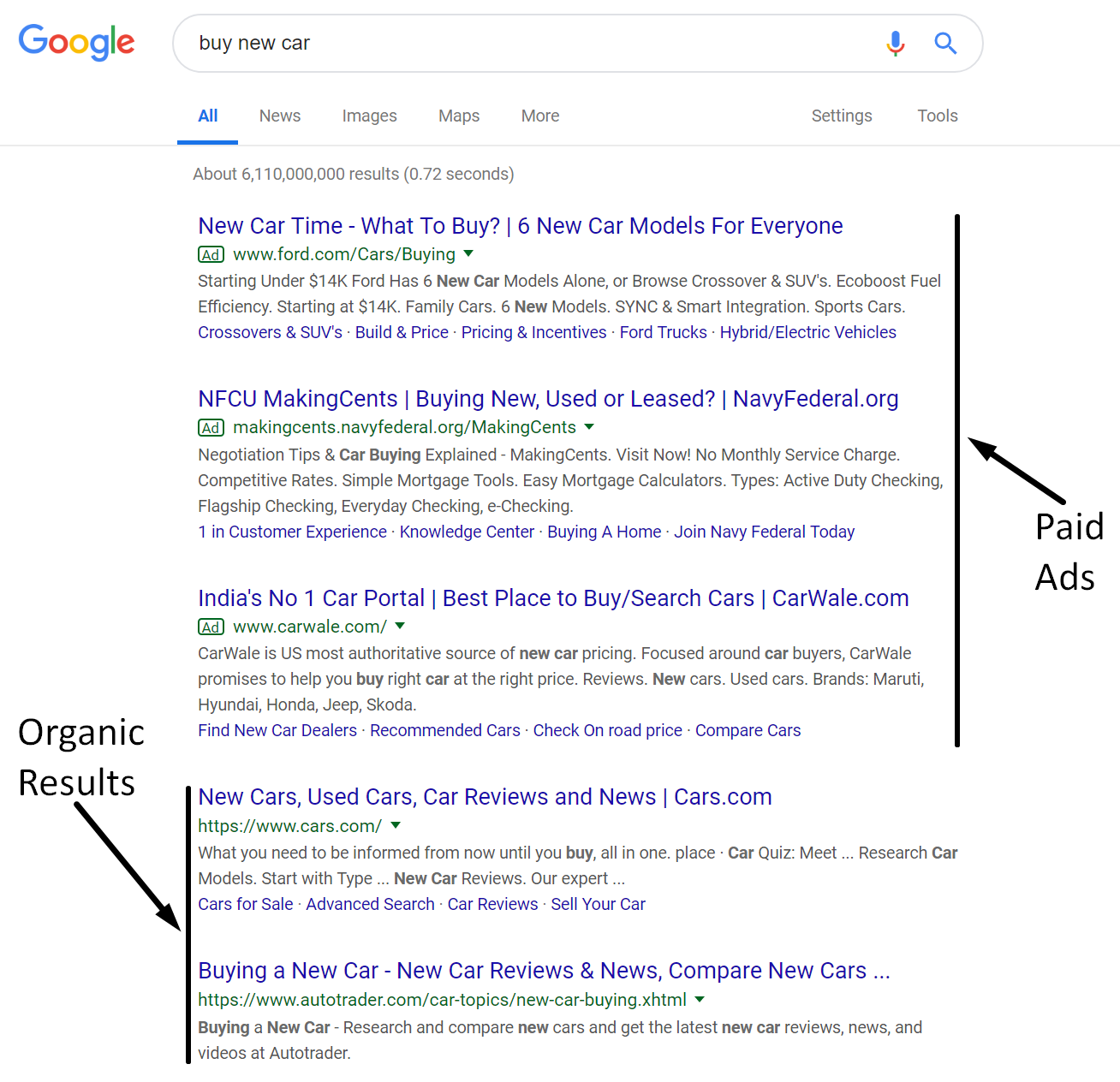
Google Ads appearing above organic results.
SEO vs SEM: The Simplest Way to Understand the Difference
Here’s an example I personally like.
SEO is like planting a mango tree.
You invest time, effort, and patience. In the beginning, nothing happens. But after some time, the tree starts producing mangoes and keeps giving results.
SEM is like going to the market and buying mangoes.
You get them immediately, but every time you want more, you have to pay again.
Neither approach is wrong.
They’re simply built for different goals.
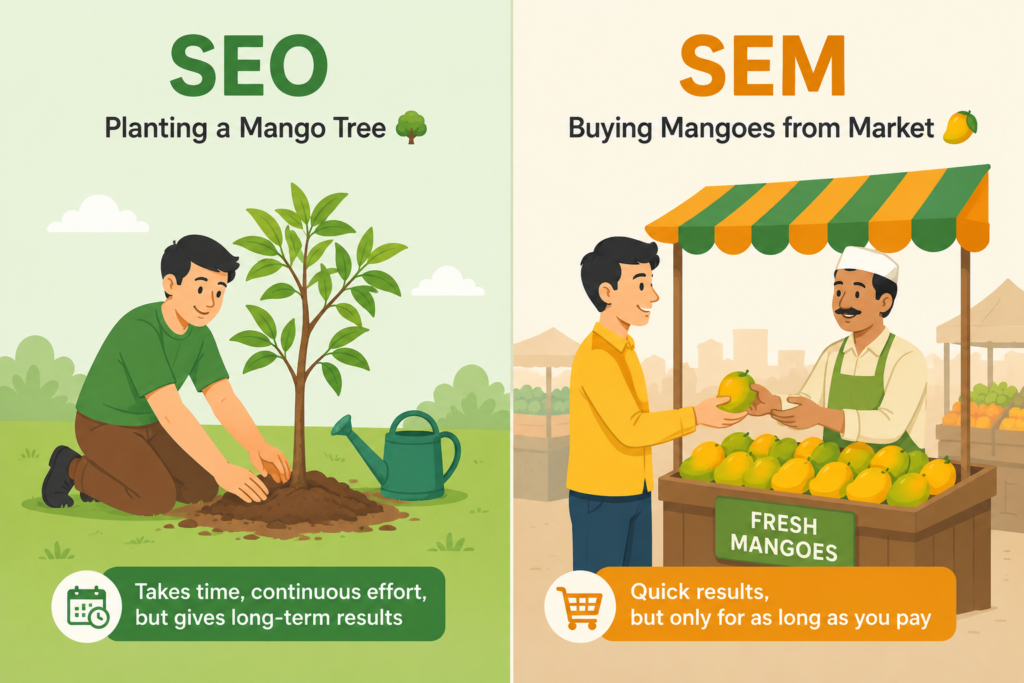
SEO → Planting a Mango Tree 🌳
SEM → Buying Mangoes from Market 🥭
SEO vs SEM: Which One Should You Choose?
Many people think businesses must choose either SEO or SEM.
In reality, most successful companies use both.
Take Amazon as an example.
When you search for products, you’ll often see Amazon ads.
That’s SEM.
At the same time, millions of Amazon product pages rank organically on Google.
That’s SEO.
The same thing happens with Zomato.
Zomato ranks for thousands of food-related searches because of strong SEO. But during campaigns and promotions, it also invests heavily in Google Ads.
Another interesting example is Swiggy’s marketing strategy, which combines customer acquisition and retention techniques.
Even a local gym can use the same strategy.
It might run ads to get members quickly while also publishing articles like:
- Best Gyms in Kanpur
- Weight Loss Tips for Beginners
- How to Choose a Fitness Trainer
The ads generate immediate leads, while the blogs help build long-term traffic.
| Factor | SEO | SEM |
|---|---|---|
| Cost | Free traffic | Paid traffic |
| Speed | Slow | Fast |
| Long-Term Value | High | Depends on budget |
| Traffic Source | Organic | Paid Ads |
| Best For | Long-term growth | Immediate visibility |
So Which One Should You Choose?
If you’re a new business and need customers quickly, SEM can help.
If you’re building a website for long-term growth, SEO is usually the smarter investment.
And if your budget allows it, combining both often gives the best results.
SEM helps you get attention today.
SEO helps you build visibility for tomorrow.
Final Thoughts
SEO and SEM are often presented as competitors, but that’s not really true.
They’re teammates.
One helps you earn traffic.
The other helps you buy visibility.
The smartest marketers don’t argue about which one is better.
They understand when to use each one.
If you’re learning digital marketing, understanding this difference is one of the first steps toward understanding how businesses actually grow online. While SEO and SEM help drive traffic, branding also plays a major role in long-term business growth. You can see this in our article on branding lessons from Apple.
What is the main difference between SEO and SEM?
The main difference between SEO and SEM is that SEO focuses on organic traffic while SEM focuses on paid advertising.
Is SEO better than SEM?
Neither SEO nor SEM is universally better. SEO is ideal for long-term growth, while SEM is useful for immediate visibility.
How long does SEO take to show results?
SEO is a long-term strategy and often takes several months to produce meaningful results.